Spirituality

Consideration of my spirituality after a stroke

Peter Ellis, July 2025

I am the first to admit that I may not be the most qualified to write about spirituality, but I can only speak from the truth of my experience. My Christian faith has been and continues to be a vital part of who I am. I was raised within a strict, evangelical Christian church and tradition. I know I carry my own bias. Still, I believe that faith and spirituality have much to offer, especially in our diverse society where, at its best, different faiths and even those with no faith, can live and work together for the common good.  This I feel is important if spiritual care is to be taken seriously within any care setting, reognising that many find their support through their own faith community. I found that the offer of spiritual care was very little, if non-existent whilst in hospital after my stroke.

But spirituality, I have come to believe, is not about a tradition or institution. It is  something much deeper. It’s personal and private and it is a a core part of our humanity. It is the quiet voice within that asks, “What is the meaning of this life? Where is God in all of this? What matters now?” 

There is a moment in the spiritual contemplative life — and perhaps in every life — when God appears to vanish.  These are the times when the language of faith no longer fits, and prayer hits a wall.  The soul, once alight, seems dimmed and even beauty seems beyond reach.   

For me, that moment came after my stroke.  Like many people throughout my life I have  experienced loss, grief and disappointment. But this is different. It is humiliation at the visceral level. My body, once so capable, now needs help to dress, to walk and to do many other ordinary, everyday things. Everything has to be relearned. My life has become narrowed. My confidence has withered and at times I feel l am burden. 

It is not only my body that  has faltered, but my image of God.  My prayers have, at times become elusive, and God seems to have disappeared . There was no sense of divine presence, just the rawness of being alive.

I realise we each express spirituality differently. For some, it is grounded in a particular religion. For others, it is a broader search for connection, purpose, or transcendence, sometimes without naming God at all. But at its heart, spirituality is about longing for healing, for understanding, for home.

Julian of Norwich speaks of the “oneing” of the soul with God — not through striving, but through surrender. She writes, our souls can experience both love and suffering.   But suffering can be transformative, bringing us to a place of learning and a deeper faith, despite the pain (Rohr, 2011). Rather than seeing our disability as a tragedy with no meaning or purpose it could be the opposite (Nouwen, 1979). I find this thinking a massive step towards integrating and fully accepting what has happened to me, and yet believe the truth in it.

A Life changed by stroke 

In March 2018, just six months after retiring early, I had a massive stroke at the age of 58. It changed everything and twice I nearly died. I have since developed epilepsy and had a number of falls and various fractures,  one that led to a full hip replacement.   My life, as I know it, collapsed.  I know I hated all those visits to A&E as it highlighted my vulnerability and loss of my independence and represented for me entry into my “new life”. It has been a humbling and frightening experience wondering what the future might hold for me.

The stroke has left me severely disabled, and, having lost the full use of one side of my body, I now, most of the time use a wheelchair. And I’ve lost things that are harder to name such as my independence, my former role in society, and at times, my sense of self-worth. I watch others (friends, colleagues, even strangers) going about their lives with ease, walking free, using both hands, and enjoying things I can no longer access and I feel a deep sadness.  

When my stroke hit me, I remember collapsing and thinking it might pass. But when my arm flopped to the ground and I slipped into unconsciousness, I realized something much more serious was unfolding. I sensed I was crossing a threshold between life and death.   I wondered, with curiosity about what was going to happen next. Strangely, I wasn’t afraid. My husband, Duncan, found me and called for help. When I regained consciousness, the anxiety did come—especially the urgent need for treatment. I had a brain bleed, not a clot, which meant the time window was less critical. Still, it all felt frighteningly fragile.

Before the stroke, I was already on a journey of deconstructing[1] my inherited faith. I had been questioning many of the doctrines and traditions I had grown up with. That journey continues, and though it is sometimes unsettling, it is also exhilarating. The spiritual life can move from “order”, through “disorder”, into a deeper “reorder”. It can be chaos until a new construction is found (Rohr, 2011).  My stroke didn’t derail that journey, rather it deepened it and it continues into a new understanding of faith and indeed spirituality. 

Asking “why?”

Suffering has a way of awakening the big questions: Why me?  What did I do or fail to do to deserve this? What is the purpose of my life now? Where is God in the middle of this mess?

It is not easy. There are days I feel invisible, literally looked over in my wheelchair. I feel like I have lost my place in the world. I read once, while in hospital, that strokes can leave survivors feeling “hopeless and helpless.” And that hit home.  Yet, even in the darkest moments, I sense something deeper calling me, not to answers, but to Presence.

During the Second World War, a Nazi officer taunts a Jewish prisoner, asking mockingly, “Where is your God now?” The prisoner, cleaning out latrines, replies, “Right here with me, deep in the poo.” That line has stayed with me. It was not irreverent, it was holy, that even there, in the most undignified, bodily places God is down here in the mess, not digusted with it, rather to be with us in the loneliness, in the pain. For me, it’s the raw truth. God isn’t perched above suffering, issuing commands from a distance.

If God is truly with us then there is no place he does not go. Including the shame and frustration of my broken messy body

That is where I find God now.  This can be in many ways. I find God in the kindness of my husband who cares for me, but also in the frustration and fatigue I feel. Having to accept being the recipient of care and support when I was always the one in charge! I find God when I express my vulernability in the many tears.

Three perspectives of Spirituality

In my experience and following my stroke, reflecting on my spirituality and faith, I see it unfolding in three key ways:

1. Internal Spirituality

This is the deeply personal journey with the soul’s quiet wrestling with love, loss, and longing. It involves a yearning for meaning, a hunger to connect with something greater than ourselves. For me, this has included facing my pain, asking hard questions, and listening, really listening, to what my heart and God is trying to say.

2. Contemplation, Suffering, and Stillness

Suffering, strangely, can become sacred ground. It strips away illusions and demands honesty. In silence and contemplation, in simply being, we can meet God. Not the God of easy answers, but the God of presence. Sometimes, I just sit and breathe and cry. That too is prayer.  I find at times I actually get tired of all the crying and want to say “enough”!  If we do not deal with our pain, it is highly likely to come out in other ways[2] (Rohr, 2004 p.25).  Contemplation gives us space to begin that transformation.

3. Compassion and External Action

Spirituality isn’t just inward-looking. It spills out. It leads to action—often quiet, often unnoticed, but rooted in love. Compassion flows from the depths of suffering. I have seen it in the hospice world where I used to work. I have seen it in interfaith initiatives, local community projects, and ordinary people doing extraordinary acts of kindness.

Before retirement, I served as chief executive of a children’s hospice. Our core purpose was to “accompany families from life through death, creating positive experiences along the way to become good memories for the future.” That work felt holy. Although I no longer lead such efforts, I still believe my life can still be of service, perhaps now in quieter, less visible ways.  I am finding setting up and running a local stroke support group has been so rewarding. A group of people meet once a month, and we. open up about our experiences. Friendships have been formed and mutual support offered outside of the meeting space. When one member said to me: “this gives me hope”, I was deeply moved. 

Faith After Deconstruction

My Christian faith remains, but it has changed.  It is less certain, and yet more spacious.  My faith is not so much about rules, but about relationship, and I do not seek definitive answers, but a quality of presence. I am still following God, but with new eyes and, often, with limping feet. It is indeed aiming for a more mature, adult based relationship rather than one that is fear based, concerned with reward and punishment.

Is my suffering a gift? I don’t know. That may be a stretch. But it has carved open a space within me where God and I can meet again—not as before, but honestly, vulnerably, even bitterly at times. And maybe that’s real faith—not having it all figured out, but staying in the conversation and uncertainty. 

Final Thoughts

Spirituality, for me, is no longer about rigid belief or exclusive traditions. It is about the human search for meaning, love and connection. It includes people of faith and people of none. It welcomes doubts, embraces mystery, and honours the sacred in suffering.

If you find yourself in pain, in grief, in transition—know this: you are not alone. And you are not irrelevant. There is something deep and real still unfolding in you. Maybe, just maybe, that is where God is—down in the dirt with us, whispering, “You’re still here. Let’s keep going.”

Maybe the spiritual life is not about rising above, but sinking deeper into what is. Maybe healing is not escape, but presence. Maybe the deepest faith is not clarity, but accepting  our new way of life

Into that space of raw vulnerability, I offer this prayer — for myself, and maybe for you too:

God of the broken
I don’t know how to live this life now.
Everything feels smaller, harder, lonelier.
I miss who I was. I miss what I could do.
Some days, I miss wanting to go on

If you are near, then be near to me here—not in the place I used to be,
but here, in this painful, narrow place.
Let me know that I still matter. That I am still yours.
Help me carry this sorrow with honesty.
Help me see, one day, some light ahead.

Even if I can’t walk far, or even hold things well
Let my soul still walk with you and be held by you
Even if I can’t speak clearly,
Hear the truth I cannot say. Hold me now. That’s all I ask.


Amen.

I am still here. I am still learning. And maybe — slowly, quietly — I am being remade.

Peter Ellis

July 2025

References

Julian of Norwich, 1998. Revelations of Divine Love. Translated by E. Spearing. London: Penguin Classics.

Nouwen, H.J.M., 1979. The Wounded Healer: Ministry in Contemporary Society. New York: Image Books.

Rohr, R., 2011. Falling Upward: A Spirituality for the Two Halves of Life. San Francisco: Jossey-Bass.

Rohr, R., 2004. Adam’s Return: The Five Promises of Male Initiation. New York: Crossroad Publishing.


[1] Deconstruction is about critically examining and reevaluating religious beliefs once held, typically beliefs inherited from family, community, or religious institutions.

[2] Rohr, R. (2004) Adam’s Return: The Five Promises of Male Initiation. New York: Crossroad Publishing, p. 25.
Letting Go

It has been a long time since my last blog, But here I am I’m back! 

Stroke really brings your mortality to the fore of your mind.  Recently I have been thinking about death and about my legacy. How does that make me feel? 

It gives me a sense of urgency (and this can be typical for people who have had a stroke as I found out from those in my stroke support group). What do I need to do?  Who do I want to see? I think I drive Duncan a bit crazy. I have slowed down a bit recently but that urgency continues more quietly inside.

I read somewhere research has shown that a person who has had a stroke caused by a bleed into the brain (and mine was a massive one) has an average life expectancy of 7 years. I am 5 years post my stroke, which means I might have 2 years left. When I say this to people, I get a response of “don’t be silly now”. Yes, I am probably being a bit of a drama queen. When I asked one of the stroke consultants how long had I to live she said “you should get a card from the King”. Now it’s my turn: “Don’t be ridiculous”.

All this means that I have sorted out a lot of papers, cards letters and other memorabilia. I am also visiting London (on my own in my wheelchair) to see people and catch up. I am loving it. It has become rather cathartic

As we all get older we face our own death. Indeed, it is a fact that the moment we are born we are on the trajectory towards our own death whether it is in a few days or 100 years!  It is difficult for all of us. I am acutely aware that I am now getting older but despite my relatively early age my stroke has catapulted me into the ‘second stage’ of my life.

I have some long term (40 years) wonderful friends who I knew from my Sheffield days, and 1 of their 4 sons and his wife (and son) came to stay with us recently. My mind has been resolved to start giving things (”stuff”) away.  Join the queue please, it is very valuable of course! I gave my record deck (21st birthday present) and records to Jim. It was hard.  It was quite painful, I want to give it to him and I know he will appreciate it (it’s retro – it’s 42 years old) and I have known Jim for 40 years. He and his brothers are like my own extended family I want to give “stuff” away to people I love. Nevertheless, it brings to the fore my mortality, and I am trying to work out how I feel, and what next.  It’s very strange place to be in. 

Throughout most of my working life I had a special interest in death, dying, loss and grief, and how healthcare staff dealt with it (probably not too well much of the time). Now I am facing that challenge myself. Perhaps the reality is more challenging than working beside it.

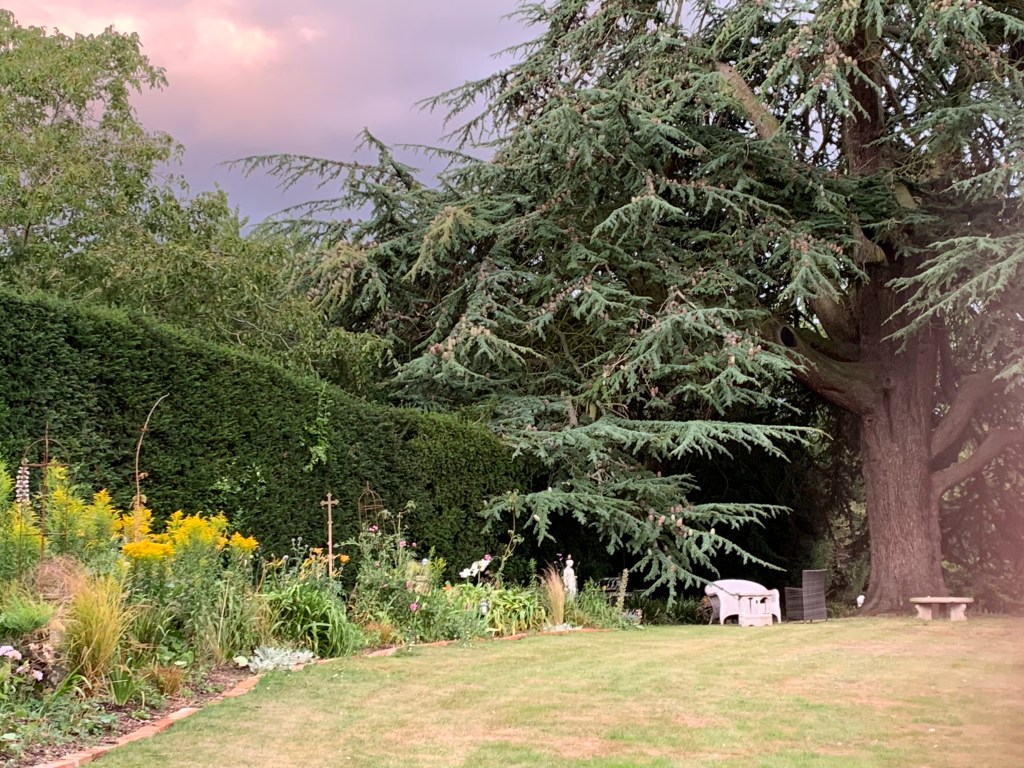
I sit in our amazing garden, the church bells are ringing, the sun is glorious the birds are singing loudly. What a treat, life is special and the afterlife, I anticipate, will be the same, and I do believe this to be the case. So, there it is. Now I must go back to living.

Peter x

Autumnal Crocus

Unbearable

It has been 4 years since my stroke and I have been reflecting about my predicament. When I get distressed and upset, I try to find words to describe how I am feeling.  So here I go. My attempt. It feels as if I cannot escape, I don’t know what to do with myself, there is a rising lump from deep down in my belly and I need to run and get away, to find a safe space from which to escape this sense of life being unbearable, and which might be my lot for years and years”    

This evening I watched the programme Caring for Derek (worth a watch on ITV) made by Kate Garraway as Derek her husband survives and lives through the long-term damaging impact of Covid. “It’s just an impossible task that you must make possible every day” Kate says. It reminded me of how I was at the beginning of my stroke (well that is how Duncan described me). The film of Derek, the description of his life and for Kate came across as impossible and harrowing and very much felt like my own experience. 

This made me reflect further that there is much in life that can be described as unbearable. After my early retirement and in my last job, we recognised that the death of a child or young person had a massive impact on the family and the community surrounding them. It is unbearable. Then more, I have witnessed others with the unexpected or even the expected death of a partner which is totally devastating, heart-breaking, horrific and I cannot imagine how that would feel. 

All this makes me feel that in comparison my unbearable seems insignificant. However, it is my reality, and therefore feels unbearable.  When I was a child, life at times felt unbearable. After the acrimonious separation of my parents, I would be terrified, sick in my stomach if I knew they were going to meet and see each other.  Not a good way to start life, and now as I face my final years (I can hear some people tickle me with the words “drama Queen”) it can feel unbearable. My distress causes me to recognise that after my stroke I am not able to do much to even look after myself, such as getting dressed, tying my shoe laces, which are some examples of how I am unable to carry out my necessary daily activities, those that previously, I did not even think about. I certainly cannot do a lot of the other activities I was looking forward to, such as gardening, cycling, piano playing or cliff walking. I cannot even contemplate doing these things ever again. It gives me a huge sense of loss and pain. I have been robbed at the end of my life.

I looked across to Duncan after supper the other evening and said “I am not sure I can bear this anymore”. It was one of those moments when, for me it felt unbearable – not being able to do very much, certainly not what I had hoped for in my retirement. Yet for a lot of the time I do bear it. I have no choice, I have to “get on with it” and as some often say, “suck it up” (by the way, I hate that expression). When I am in the middle of my unbearable I somehow find the strength to carry on. For me the reality of my circumstance can come and go, in waves rather like the experience of grief, thus offering respite.

The other evening, I watched the programme “portraits of the Holocaust” describing the unimaginable stories of those who had survived.  The stories the survivors told were harrowing. Indeed, their circumstances seemed to me to be unbearable. “How can I complain” I thought?  Yet they survived to tell their stories

I often ask why this has happened to me. It feels unfair and unjust.  But there is much I can continue to do. My cognitive skills are in intact and I can use that for my own benefit as well as for others. Yet I must be careful and be honest and not let my natural (positive) personality defend me against my loss and pain.

I am a type 7 in the enneagram, a typology system that describes human personality as a number of interconnected personality types (www.verywellmind.com) According to my typology I have a positive, idealism, radiating joy and optimism (oh goody!), but all of this is there to defend against my underlying need to avoid pain.  So here I am bearing an unbearable burden, but with a personality that tends to see a cup half full, not half empty. Will this enable the bearing of the unbearable? This is the challenge that I face as I look to the future.

Peter

February 2022

Where do I go from here?

My good friend, Val has been talking with me about the tension between my rehabilitation and acceptance of my disability and status. Perhaps this can be interpreted as that I will make some progress towards restoration, independence and freedom, but I need to work towards acceptance of my disability, integrating this within my life.

This is good in principle but I find there is a need (and Val, being a therapist, fully understands and agrees) to allow the grieving process to continue.  Some mornings I wake up and it suddenly hits me again.  I find it can be really painful even 3 years on, the loss and the long-term consequences of my stroke, something that happened in an instant, when I collapsed to the ground thinking “ok, this is strange but I will come round” like you normally do when you feel unwell.  It was a very odd, and frightening, yes a terrifying experience and I did not come round.   It exploded out of nowhere and it smashed my life into bits.  Why?  But why not? Life is complex, there is no way of understanding what can be around the corner, and as we all appreciate, life is incredibly fragile.  Just look what is happening in Afghanistan at the moment. Out of nowhere people’s lives have been shattered and changed without knowing what the future holds. But then this is so true for all of us and especially as we get older, with our gradual decline perhaps exacerbated by some form of disease or life limiting condition. 

We all live with some form of loss and hold grief whether we are ageing/declining or had a dramatic explosive event.  Death, dying, loss and grief is everyone’s business, and my point is that recognising life is fragile, life is to be lived with everything it has to offer, whilst there remains the tension between acceptance and restoration living with love in all its fullness, knowing we are loved and can love. Enjoying life and dancing because whoever you are whatever your circumstances, you can.  

So, as someone said to me the other day, be grateful and give thanks you woke up this morning.

A guest blog by Pete Jones – A new way of playing the piano

Sometimes when a personal crisis happens, family and friends often step up. Pete is one such friend (and many friends have been and have offered amazing support), Pete’s offer is unique and I asked him if he would offer a guest blog.  Here he tells his story….

Continue reading

Locked Rooms

I begin by using a quote that inspires me;

“You are so young, so before all beginning, I want to beg you, as much as I can, to be patient toward all that is unsolved in your heart and to try to love the questions themselves like locked rooms and like books that are written in a very foreign tongue. Do not now seek the answers, which cannot be given you because you would not be able to live them. And the point is, to live everything. Live the questions now. Perhaps you will then gradually without noticing it, live along some distant day into the answer.”

(Rainer Maria Rilke – Letters to a Young Poet, 1929)

I am not sure I qualify as young but this spoke to me, with thanks to the lovely Kim Oliver for sending the book to me.  I think it is my emergent strategy.  When I studied for my MBA, one of the concepts that came forward was “emergent strategy” described by Mintzberg (1939), as opposed to a planned strategy 

 As I reflect back on my work (my last job) we spent a lot of time developing the strategy of the organisation, considering the future including a vision and mission with strategic and operational objectives. Many were not achieved fully or as intended, presenting good examples of emergent strategy.  I feel sadness that some of the key objectives, whilst there was some progress made towards our vision this will be lost as the organisation has changed shape having a different focus towards a new vision 

My life has been turned upside down, I have no idea at times what is going to happen next! Grief can cloud so much. It can get in the way of using your situation towards unexpected goals and ambitions. Thus, managing sadness, grief and the sense of loss has to be done, definitely acknowledging it which is very important, but not letting it get in the way. Claude AnsHin Thomas (2004) said “when you discover the liberation that comes with stopping the struggle and becoming fully present in your own life. This is the real path to peace and freedom”. How true is this for all of us.  Now, I do not know what my “fully present” means for me (can any of us understand this without reaching for it), but it noted there is work to do, and I suspect the process will be revealing, healing in its own way. As my good friend Val reflects “there is a balance between acceptance and perseverance.  However, accepting that there is no use in my left arm/hand, whilst tottering along on a weak left leg rather like a snail undulating and sliding (yuk, nasty – be careful now Peter you might be reported for “Gastropod phobia” !). It is so tough and painful both physically and emotionally. My room with the answer might be locked at the moment and my patience and faith will be sorely tested but I will continue in the hope that something good and positive will emerge in the course of time.

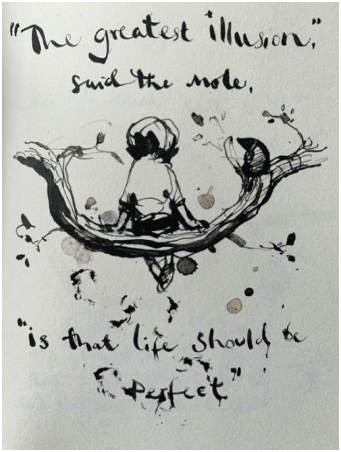
A lot of people use the drawings and work of Charlie Mackesy so I am joining in

Peter.   May 2021 

Antique

My lovely physiotherapist, Scott has been encouraging me about how to consider my future.  He offered an analogy: “think about yourself as an antique (“rude” I said), even an antique that cannot be sold at the auctions (even more rudeness!) yet the flaws, the cracks and imperfections are what will be used in the future – the patina I described it as. This reminded me of the Christian concept of brokenness and how we as people can only be used when we are broken vessels (typically) so, wise words from a young man! Another good friend/former colleague, Heather suggested the Japanese art of Kintsugi which illustrates the philosophy that nothing is ever truly broken. This technique repairs broken pottery by using beautiful seams of gold.

I reflected on this and recognised this as perhaps describing the second phase of my life as ostensibly defined by the Franciscan priest and theologian (mystic), Richard Rohr. It makes me wonder whether my physical catastrophe has led to an emotional/mental catastrophe inviting me to enter into the second phase (not expected nor wanted, of course) but it describes a role I could play as someone to use my disability in a positive way, the cracks, the flaws and the brokenness … but oh, the way I see things at the moment, I want to be restored to my former self.  Of course, this is not and will not be possible.  Acceptance is very, very hard.

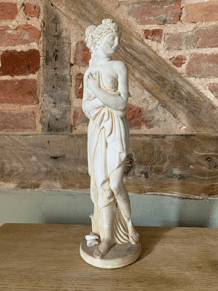
An image of a small figurine broken whilst decorating. It has been repaired. It remains with a fractured look but can still be of use.

BROKEN

RESTORED

A Question

Some have asked, indeed so have I, what is the point or the purpose of my blogs? Many have said “Well they must be cathartic for you?” The answer is yes, I have found them helpful. I have also been told that some people have found them raw and painful which is not a bad thing if it helps people realise my predicament. But one of the main purposes of my blogs is to help others to have a better insight of a person aiming to live after a stroke. Does it achieve this?  

Please do leave your comments and email address below.

Goodbye to the shoes and waves of grief

Those who know me well will know how much I enjoy my shoes (well at least I used to!), I think men can enjoy them in the same way as women?  Or am I unusual? Anyway, my point is we are beginning to look through my wardrobe, and we were going through all my old shoes. I was hoping I could at least wear some but alas none would fit my swollen left foot. A very brave decision was taken. They were reluctantly all put into a black bin liner and disposed of. It was painful as it represented that part of my life which is now finally over!  I inevitably cried at another loss. 

I find my memory of my losses hit me sometimes unexpectedly, like waves and it can feel immensely painful. The pain appears to emerge from the depth of my being. I have an overwhelming sense of not knowing what to do and how to survive my horrific situation. I have said it several times but the thought of not being able to do what I used to be able to do for the rest of my life is incredibly distressing, overwhelmingly so. I cannot fathom it. The thought of not being able to ride my bike, kneel down in the garden and feel the soil, walk along the beach, feel the sea wash over my feet and feel the sand beneath them, to walk along the footpaths of the Cornish cliffs especially those I remember as a child and which I have visited from time to time since then. The ability to walk into town and pop into the local shops indeed to drive into one of the local cities (Norwich, Cambridge, Bury St Edmunds), and go shopping, to go to Waitrose on my own, oh the joy!  All these things, and many more are not going to be easy to do if at all, and certainly not on my own in the future. Life has changed beyond recognition for me.  Am I going to be trapped inside the house, sitting in a chair reading, reflective writing, watching TV for the rest of my days (I can recite the daily TV schedule for you if you wish!!)? Is this the best it is going to get?

Hey! Stop feeling sorry for yourself (I can hear my mother say!!), but my pain (as I describe it) is there, it is real and I need to have it validated. Yes, I experience physical pain (from my various fractures, my shoulder, caused by the neuropathic pain – the nerve endings damaged by the stroke down the left side of my body). By the way I had another fall on Christmas Eve ending up in A&E resulting in a fractured shoulder (will this ever end?) But it is the emotional and spiritual pain I experience that washes over me on a regular, often unexpected times which feels much worse than the physical pain. I do wonder sometimes if others really understand what it is I am experiencing. But what the heck, what can they do about it anyway? I always think when I experience my grief episodes that there is going to be help at the end of this, that one day I will look back and recount “do you remember when?” I also think life will return to my old normal, but I know that is not going to happen.  I remain in hope that I will regain some form of function that will allow me to lead a reasonable life, but I know it will take a good few years.  My emotional pain increases when I think about this. I had my stroke when I was 58 I am now 60 years old and 70 will soon be upon me!  Time is drifting away, I hope I am table to achieve more before I die!

We are all currently experiencing the national lockdown. This has caused a lot of people serious challenges for their mental health. Depression, frustration and loneliness are all common experiences, but knowing this will one day come to an end helps us to cope with the situation, I wonder if it will make much difference to me? 

Living with disability

From a discussion in my last blog about suicide to now about living!  Recently I have become acutely aware of the confines and constrains physical disability has on my life. Having worked for a number of years with children and young people who had severe physical and mental disabilities I had no real idea of their internal struggles of not being in control of their own lives.  Now I am experiencing all this first hand. The shear frustration at the lack of independence (being in control); privacy and dignity and how often have I had to accept family and friends showering and toileting me – this is all acutely embarrassing, maybe not for them but for me. 

I am now beginning to make good progress towards some level of physical recovery, indeed I am now able to use my stick to walk independently. I can now walk up and down our staircases (with Duncan’s support) all thanks to my physiotherapy.  I attend a super gym facility, a charity set up by an orthopaedic surgeon (Rachel) and a boxer (John or Mr Shouty as I call him!!) the gym is for those with a disability or needing some form of physical recovery. Called Able2be in Norwich.   At this gym I was introduced to Scott Rowbotham (physiotherapist) and a member of his team, Jill (personal trainer) both of them are fantastic – they understand not just my physical wellbeing but also my emotional and mental wellbeing, and how these impact on my physical recovery.  They also both acknowledge my experience and background, thinking of ways in which this can be used.  We have great fun together (believe it or not but I now even look forward to my gym sessions – who would have thought I would actually be saying this!).  One of the aims I have is to increase the movement and some function in my arm and hand so I am prepared to enter the upper limb restoration programme at the hospital for Neurology and Neurosurgery, Queens Square, London, led by Professor Nick Ward. [With thanks to Nigel Love for the introduction].  Whilst I cannot hold any great expectations, I feel I have some hope.  If I can get some form of restoration in my arm and hand it would make a massive difference.  The loss of function in a limb causes huge Limitations. It is a devastating consequence of a stroke. Thanks to Scott I am beginning to learn to walk without a stick (haven’t tried it at home yet!). It is a very wobbly start but I cannot express enough my happiness that this is happening. Suddenly what I thought was impossible and never going to happen again has now become a possibility. When this lockdown is truly over, and things get back to some sort of normality, I feel I will now be able to walk into the Auction sale rooms and look at the items I want to put bids on!

Joy of joys. I am now on my mower again (with a little lift up from Duncan!), another thing I never thought I would do again.

Don’t get me wrong I still get distressed, feeling incredibly sad about my loss but there is a ray of hope as I continue to make progress towards some form of recovery.

I am totally in debt to Duncan for his massive support, love, care and especially his patience with me!

Peter xx

A difficult subject

Stroke and suicide a personal note

As you approach this blog I want to assure you, the reader, that I am in a good place despite what I am writing about. But I want to be honest and true to myself, as Duncan keeps reminding me.

What a tricky subject!  Suicide is often unspoken about and difficult. We don’t like it.  It is an unutterable consideration. People who have had a stroke often feel, depending on the severity, that their quality of life is so compromised that what is the point of continuing to live. There is perhaps a feeling you are too much of a burden and in the way.  Pompili et al state that “stroke is a dramatic event and is associated with potentially severe consequences, including disability, mortality, and social costs. Stroke may occur at any age; However, most strokes occur in individuals aged 65 years and older. Previous research has found that stroke increases the risk of suicide” (Pompili, et al 2014). 

I have become very distressed on occasions. The thought of being seriously disabled, is completely overwhelming, wondering if I will be like this for the rest of my life. As I write I am listening to Songs of Praise and a couple of hymns and worship songs are featured, those I used to play on the piano. I start to cry, feeling immensely sad as I will probably not be able to play again. I wonder, again should I sell my piano?

When I was in hospital I remember a woman talking in a support group, she announced that her favourite pastime was driving her car and if she could not do this again she would end her life and said she was very serious about this. I just hope this was followed up by the psychologist. I also wonder what impact this might have had on other members of the group. This encounter still plays on my mind.

I have, at times, when I am distressed, feel overwhelmed and how life would be unbearable in the future. I struggle with not knowing how to escape and deal with the loss I experience. I wonder sometimes if I would be better off dead. On one occasion, Duncan was at the bottom of the garden and I was trying to contain my distress, I was sitting by the back door and I knew there were plenty of paracetamols in the kitchen. I had a choice, turn left, walk into the kitchen and swallow a handful of them or turn right and join Duncan in the garden. Clearly, I turned right and I am able to write this now. I honestly now feel I would not really want to take this selfish course of action. Those with their clinical/therapeutic hats on – there is no need to start the risk assessment!

Research has shown that stroke patients are up to twice as likely to commit suicide as people in the general population, and the risk of attempted suicide was highest in the first two years after a stroke. Among stroke patients younger than 55, the risk of suicide was five times higher than in the general population.

When I worked in the NHS I started working towards an MPhil (I ended up completing an MBA – don’t ask!!). As part of my study I interviewed the consultant oncology staff I worked with, about their attitude towards death.  I found interesting results. A lot of the clinicians held various views on life and death and this influenced their approach to treatment offered to patients, some would go to the last possible course of treatment in an attempt to rescue the patient but one in particular stood out for me, he stated that he would only go for one round, possibly 2 but after that finish treatment as he believed we “come from dust and will return to dust” but the question remains is the attitude towards rescuing patients. Is offering treatment an attempt to preserve life at all costs worthwhile, if the quality of life remaining is poor?  A lot of clinicians felt they had failed if the patient died, despite all treatment offered. 

I was admitted via A&E when I first had my stroke. I was kept on an acute admissions ward for observation, with a view to a further transfer to a rehabilitation unit.  However, I deteriorated and was transferred to Addenbrokes Hospital for neurosurgery to open my skull and drain the bleed. It is now a thought of mine that I was subject to life saving procedures but sometimes wonder if it would have been better if they let me go.   

There is a piece circulating, via Facebook, describing a new indicator for stroke recognition emphasising the need for urgency to get the patient to hospital to make every opportunity for survival and a good recovery.   The article then makes the point that those who might survive, when perhaps intervention has been too late, might be severely disabled and become “hopeless and helpless”.  This might be true but reading this, as a so called “stroke Survivor” (I don’t like being labelled in this way!), does not really inspire or motivate me now that I have survived. This articles comment makes me feel especially angry as I, for one, intend to have hope and do as much as possible towards my recovery. 

I hope I have been honest in this blog and even more so, I hope it opens up a dialogue about this very difficult subject. It has resonance for me.  I hope you feel able to comment on this subject and open up a discussion in the comment section below. I look forward to that.